Long-term observations reveal a new mechanism: Tropical forest soil carbon and phosphorus cycles are “drifting apart”
A research team from the South China Botanical Garden, Chinese Academy of Sciences, has recently made important progress in understanding how tropical forest soil carbon and phosphorus cycles respond to nutrient enrichment. The study shows that long-term phosphorus addition increased total soil phosphorus by more than threefold, yet did not enhance soil organic carbon stocks. This provides the first empirical evidence for a striking decoupling pattern—“stable carbon pools, soaring phosphorus pools”—challenging the long-standing assumption that phosphorus limitation is the key bottleneck restricting carbon sequestration in highly weathered tropical soils. The findings offer new scientific insight for the sustainable management of tropical forests under global environmental change.
A global ecological puzzle driven by nutrient imbalance
Human-induced nitrogen and phosphorus deposition is intensifying worldwide and reshaping biogeochemical cycles. Tropical forest soils store more than 30% of global terrestrial soil carbon, and their stability plays a crucial role in climate regulation. Conventional theory posits that soil carbon stability in tropical forests is tightly linked to phosphorus availability, and that phosphorus scarcity limits carbon accumulation. However, how long-term imbalances in nitrogen and phosphorus inputs reshape the coupling between soil carbon and phosphorus has remained an unresolved question.
Long-term observations uncover key mechanisms
Based on a long-term nitrogen–phosphorus addition experiment established in 2009 at the Xiaoliang Tropical Coastal Ecosystem Research Station, the research team integrated solid-state ¹³C NMR, liquid-state ³¹P NMR spectroscopy, and soil organic carbon fractionation techniques. Together, these approaches allowed a systematic assessment of carbon and phosphorus concentrations and their chemical speciation within two functional soil carbon pools: particulate organic matter (POM) and mineral-associated organic matter (MAOM). POM originates mainly from plant residues and turns over relatively quickly, whereas MAOM is derived largely from microbial transformation products stabilized through mineral associations. These pools jointly determine the persistence of soil organic carbon.
Key findings: Soil carbon and phosphorus “diverge” under nutrient enrichment
1. Carbon pools remain stable
Nutrient additions did not significantly alter soil organic carbon concentration, the distribution of carbon between POM and MAOM, or the chemical composition of soil organic matter. This contradicts the expectation that phosphorus addition would promote carbon accumulation in tropical soils, indicating that increasing phosphorus availability alone is insufficient to stimulate soil carbon sequestration. Potential mechanisms include microbial priming effects and saturation of mineral-binding sites.
2. Phosphorus pools surge more than threefold
Phosphorus addition (both P-only and N+P) sharply increased total and inorganic phosphorus levels in soils—by over threefold. This increase occurred mainly in the POM fraction, while phosphorus in MAOM remained stable. Phosphorus enrichment also lowered soil C:P and N:P ratios, decreased organic phosphorus, and increased inorganic phosphorus proportions.
3. Functional carbon pools play distinct roles
POM serves as a responsive pool, showing positive associations with inorganic phosphorus and negative associations with organic phosphorus. MAOM functions as a stabilizing pool, with its phosphorus strongly governed by mineral protection mechanisms. Notably, MAOM phosphorus was negatively correlated with aromatic carbon and microbial necromass, suggesting that excessive phosphorus inputs may interfere with microbial pathways crucial for long-term carbon stabilization.
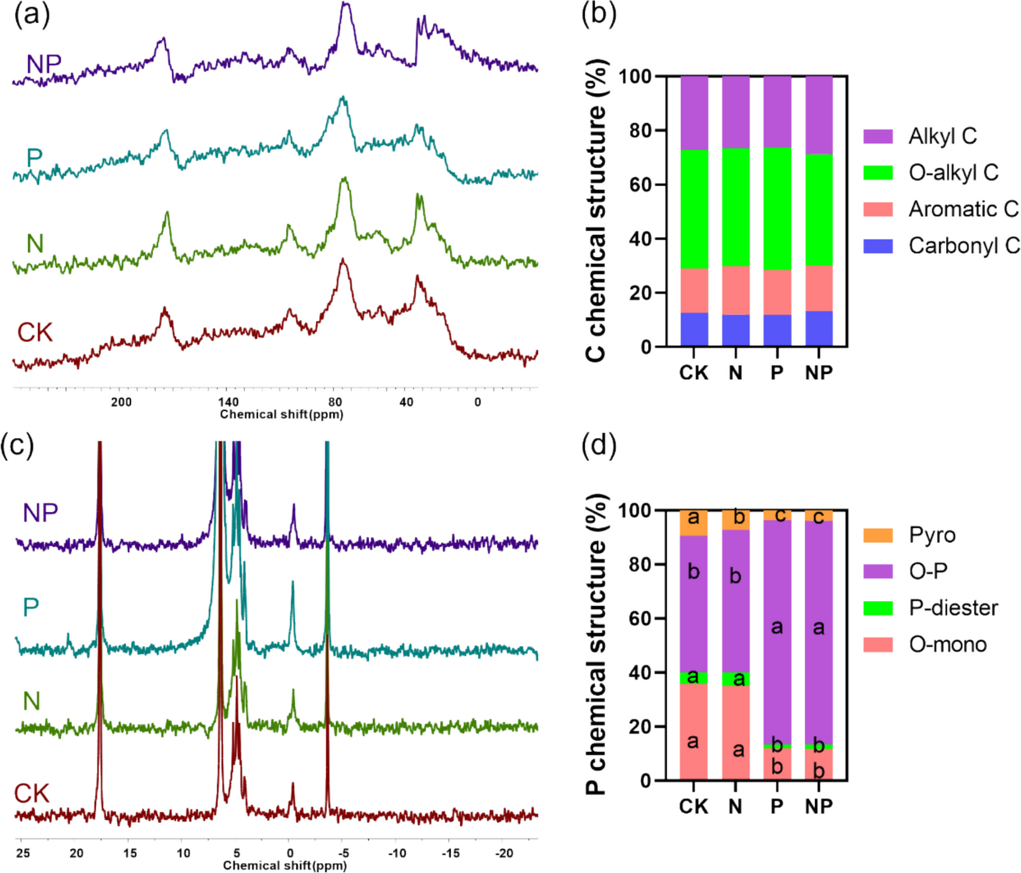
Figure 1. Chemical composition of soil organic carbon and phosphorus under different nutrient addition treatments in tropical forests. Note: (a) Soil ¹³C NMR spectra; (b) carbon chemical composition; (c) ³¹P NMR spectra; (d) phosphorus chemical composition. Pyro, pyrophosphate P; O-P, orthophosphate P; P-diester, phosphodiester P; O-mono, phosphomonoester P. CK, no fertilization; N, nitrogen addition; P, phosphorus addition; NP, combined nitrogen and phosphorus addition. (Image by LI et al.)
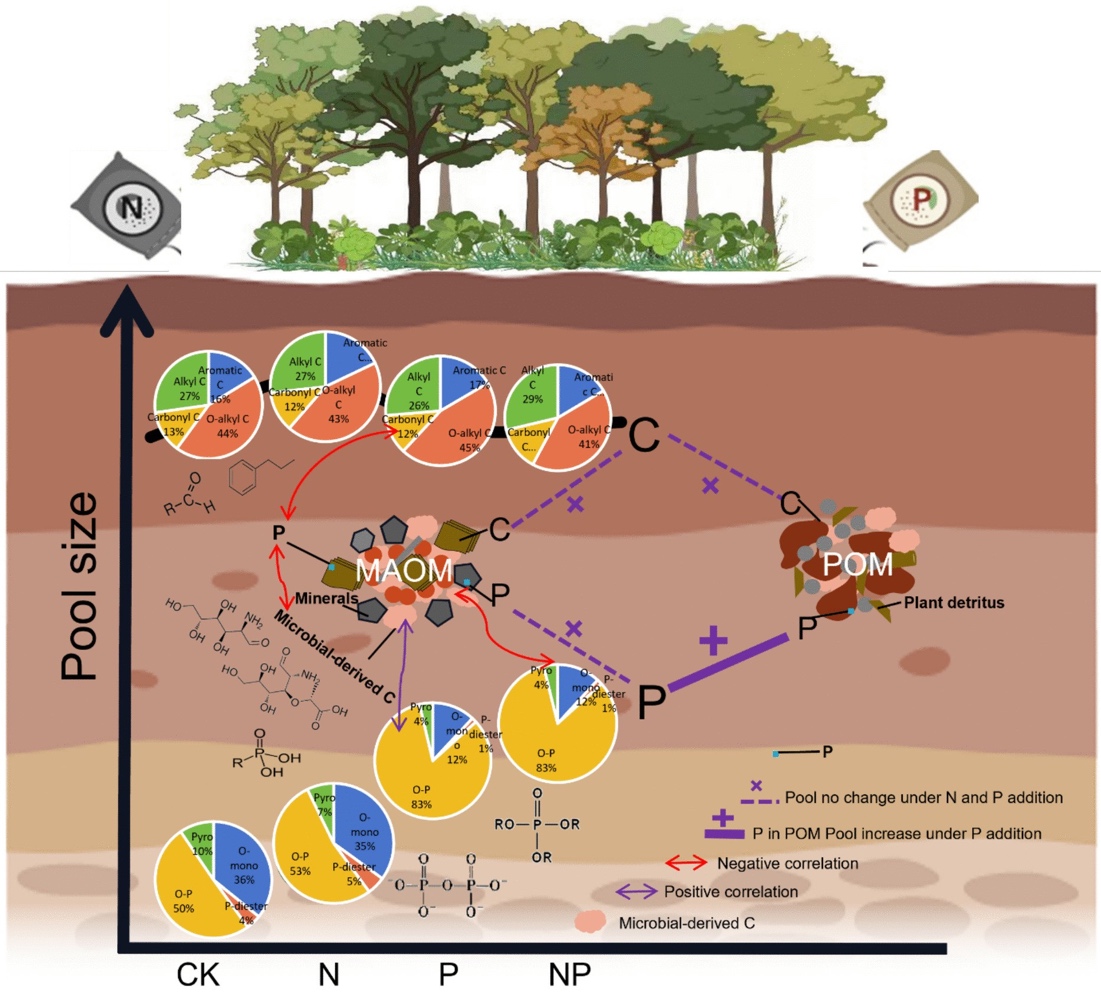
Figure 2. Conceptual diagram of the long-term trajectories of soil carbon and phosphorus pools under nitrogen and phosphorus enrichment. (Image by LI et al.)
Management implications and global significance
This study reveals, for the first time, a chemical decoupling mechanism between soil carbon and phosphorus cycles under long-term phosphorus deposition in tropical forests. The findings indicate that sustained phosphorus inputs may lead to the accumulation of “legacy phosphorus” on mineral surfaces, reducing the efficiency of MAOM formation and potentially weakening long-term soil carbon sinks. Corresponding author Dr. Zhanfeng Liu emphasizes that nutrient management strategies in tropical regions must be tailored to local soil conditions, avoiding indiscriminate phosphorus fertilization to maintain carbon–phosphorus balance and ecosystem stability.
The study provides critical parameters for global soil carbon models and enables more accurate predictions of tropical forest carbon sink potential amid climate change. Future work will incorporate isotope tracing, X-ray absorption spectroscopy, and microbial functional gene analyses to further identify sources of inorganic phosphorus in the POM fraction and to evaluate the influence of seasonal dynamics on carbon–phosphorus decoupling. These efforts aim to deliver comprehensive scientific support for sustainable tropical ecosystem management.
The findings have been published in Plant and Soil under the title “Divergent chemical responses of soil carbon and phosphorus to nutrient addition mediated by functional carbon pools in tropical forests.” Postdoctoral researcher LI Tengteng is the first author, and Dr. LIU Zhanfeng is the corresponding author. The study was supported by the Guangdong Key R&D Program and the National Natural Science Foundation of China. Paper link: https://doi.org/10.1007/s11104-025-08102-1
File Download: