Scientific Breakthrough in Blue Carbon: Mangrove Restoration Enhances Soil Carbon Sequestration via Microbial Pathways
A recent study led by researchers (Prof. WANG Faming, Dr. HUANG Xingyun, and so on) at the Xiaoliang Experimental Station has shed new light on the crucial role of soil microbes in carbon sequestration during mangrove restoration, providing a novel microbial-driven perspective for enhancing "Blue Carbon" sinks.
Published in the Journal of Plant Ecology under the title "Microbial carbon use efficiency governs the accumulation of microbial-derived carbon in restored mangroves", the research addresses a key uncertainty in coastal carbon cycling. While mangrove restoration is known for its potential to lock away atmospheric CO₂, the processes governing the fate of this carbon in soils remain complex.
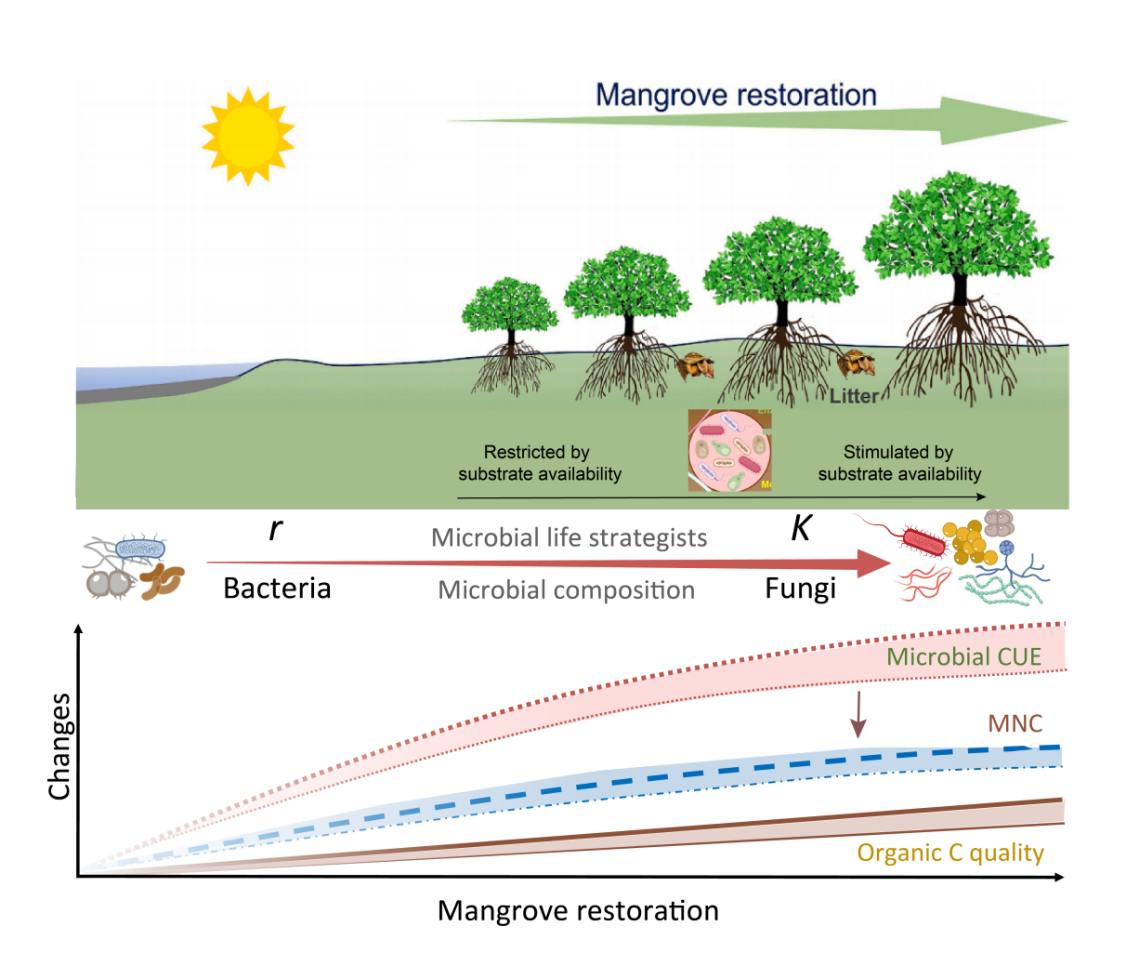
Focusing on a restored mangrove wetland on Q'ao Island, the team discovered that restoration significantly reshapes the microbial community and its function. Their data revealed a striking 37.84%–56.76% increase in microbial carbon use efficiency (CUE), a measure of how effectively microbes convert consumed carbon into their own biomass rather than respiring it back as CO₂. This shift is attributed to improved organic carbon quality and a fundamental change in the microbial community structure, transitioning from fast-growing "r-strategists" to slow-growing "K-strategists."
Critically, this enhanced microbial efficiency directly drives carbon storage. The study found that CUE was positively correlated with microbial necromass (dead microbial residue) carbon, explaining 73% and 69% of the variation in fungal and bacterial necromass carbon, respectively. While bacterial necromass increased more, fungal residues constituted the dominant portion of the newly formed microbial-derived carbon pool, underscoring the pivotal role of fungi in stabilizing long-term soil organic carbon.
The results demonstrate that mangrove restoration boosts soil carbon storage not only by increasing plant-derived inputs but also by optimizing microbial processing to favor preservation. Article link: https://doi.org/10.1093/jpe/rtaf230
 .
.
Figure. Mangrove restoration regulates soil microbial carbon use efficiency and necromass carbon formation.(Image by WANG et al.)
File Download: