Silicon vs carbon:divergence in defensive strategies of two congeneric trees across subtropical forest elevations
—— Interspecific differences in defense strategies of dominant tree species in subtropical evergreen broad-leaved forests
Inter- and intra-specific variation of plant functional traits reflect the response and adaptability of plants to environment change and benefit plants’ growth and defense under different habitats. Elevational gradient with simultaneous biotic and abiotic factors within a limited spatial scale provides an ideal platform to dissect intraspecific response and adaptation of plants to global change, in particular to climate warming. How subtropical forest trees adjust their defensive strategies (leaf Si- and C-based defense compounds) across elevations remains poorly understood.
Researchers from the South China Botanical Garden of the Chinese Academy of Sciences studied two dominant Castanopsis species (Fagaceae), Castanopsis eyrei and C. lamontii, in subtropical evergreen broad-leaved forests to compare the variations in defensive strategies across elevations.Sixteen plant functional traits of two dominant congeneric trees were detected at 360, 700 and 1045 m above sea level (E360, E700 and E1045) in a subtropical forest. From E1045 to E360, C. eyrei prioritized C-based defense by increasing leaf tannin at the cost of decreasing leaf non-structural carbohydrates. From E700 to E360, C. lamontiiemployed Si accumulation as defense by increasing leaf Si but with no significant changes in leaf NSCs.
These results revealed species-specific acclimation mechanisms of dominant trees to warmer conditions (from high to low elevations) in subtropical forests, highlighted the significance of Si in mitigating tree’s carbon cost by integrating Si into cost-benefit analysis and trait-based ecology. The results shape future shifts in tree’s dominance and productivity in subtropical forests under climate warming.
The study, title “Silicon versus carbon mediates defensive strategies of two dominant congeneric trees across subtropical forest elevations” was published in Journal of Plant Ecology. CHEN Yao and YU Heng were the co-first authors and Professor KUANG Yuanwen was the corresponding author. This work was supported by the Key-area Research and Development Program of Guangdong Province and other funding sources. Article link: https://doi.org/10.1093/jpe/rtag060
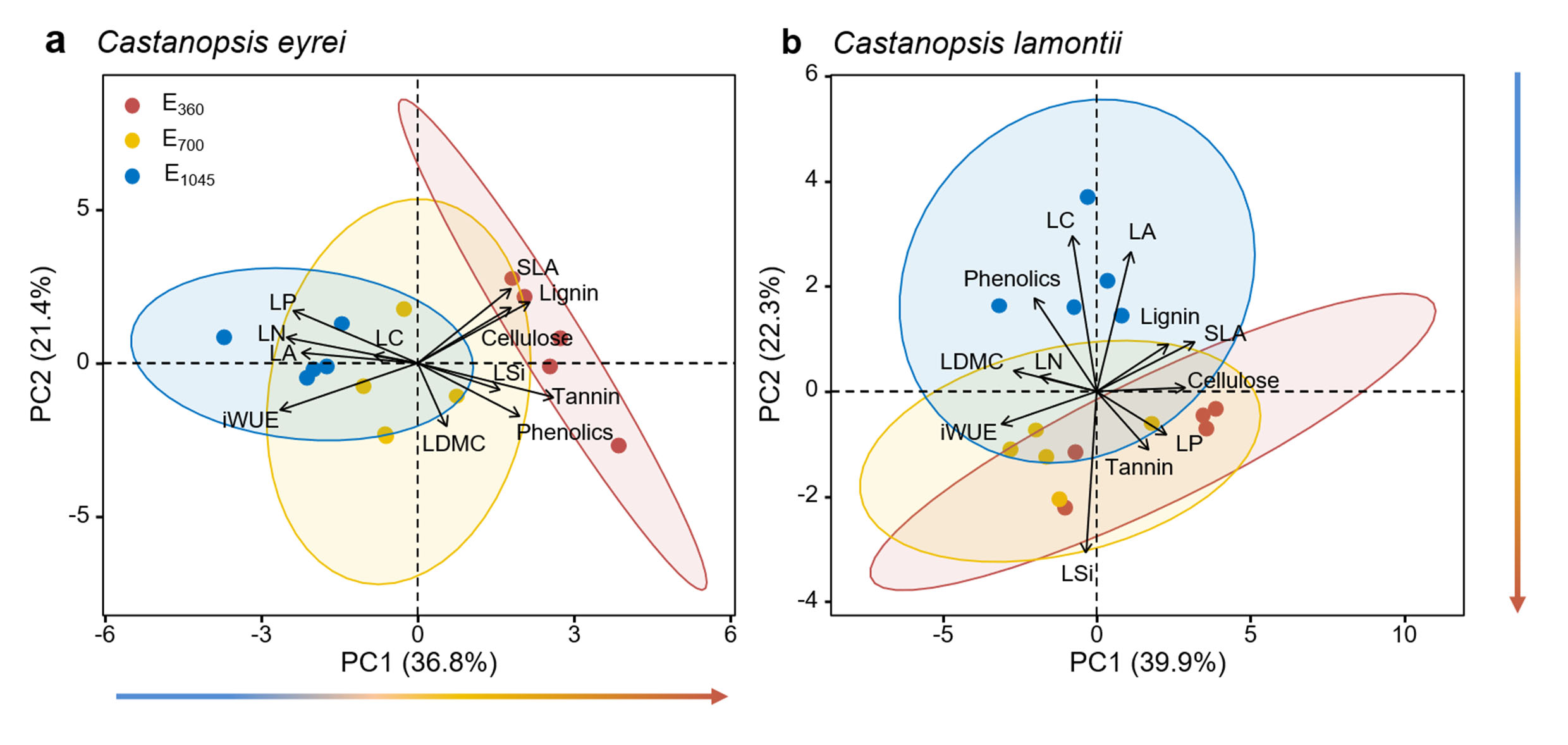
Fig. 1. Co-variation of the studied functional traits for Castanopsos eyrei (a) and C. lamontii (b) along the elevational gradient, revealed by principal component analysis (PCA).(Image by CHEN et al.)

Fig. 2. Correlations between non-structural carbohydrates (NSCs) and co-variation axes of the studied functional traits along elevation gradient in Castanopsis eyrei (a−d) and C. lamontii (e−h).(Image by CHEN et al.)
File Download: