Selective Logging Better Preserves the Adaptive Capacity of Subtropical Forests Than Clear-Cutting
Adaptive capacity refers to the ability to cope with disturbances and environmental change and offers a useful perspective for sustainable forest management. However, applying this concept in the logging context remains challenging. A key question is how different logging practices affect forest adaptive capacity.
According to adaptive cycle theory, selective logging generally causes less disturbance to forest species composition and structure than clear-cutting and may therefore better preserve forest adaptive capacity. Yet experimental evidence from subtropical forests remains limited.
Now, a new study led by researchers from the South China Botanical Garden (SCBG) of the Chinese Academy of Sciences (CAS) provides empirical support for this prediction. Using data from a long-term logging experiment in an evergreen broadleaved forest in Wuping County, Fujian Province, China, the researchers examined changes in forest adaptive capacity from 1998 to 2017.
To evaluate adaptive capacity, the researchers examined three key attributes: potential, reflecting the accumulation of species resources; connectedness, representing the rigidity of species interactions; and resilience, describing the ability of forests to recover toward the condition of mature natural forests following disturbance.
“Both potential and connectedness were at least 50% higher in selectively logged forests than in clear-cut forests,” said YOU Zhangtian, a PhD graduate of SCBG and co-first author of the study. “After 22 years of natural recovery, the adaptive capacity of selectively logged forests had approached that of mature natural forests, while clear-cut forests had yet to recover fully.”
But what explains thispersistent difference?
“Compared with selectively logged forests, clear-cut forests had higher species evenness, more light-demanding trees, and simpler tree height structures,” said WU Guilin from the Chinese Academy of Forestry, another co-first author of the study. “These differences were associated with lower forest adaptive capacity.”
The researchers also revealed dynamic adaptive mechanisms in logged subtropical forests. During early recovery (3–5 years), species evenness, light-demanding species abundance, and tree height inequality all reduced potential and connectedness. During later recovery (10–22 years), the influence of species evenness strengthened, while the other two weakened.
These findings suggest that logging affects forest adaptive capacity primarily through changes in species diversity, functional group composition, and stand structure.
“The key finding is that the factors shaping forest adaptive capacity are not static but change as forests recover from logging,” said YE Qing from SCBG, corresponding author of the study. “This highlights the importance of long-term monitoring for sustainable forest management.”
More broadly, the study provides experimental insights into how different logging practices affect forest adaptive capacity, offering a scientific basis for sustainable forest management in subtropical regions. The findings were published in the Journal of Applied Ecology. Article Link: https://doi.org/10.1111/1365-2664.70612
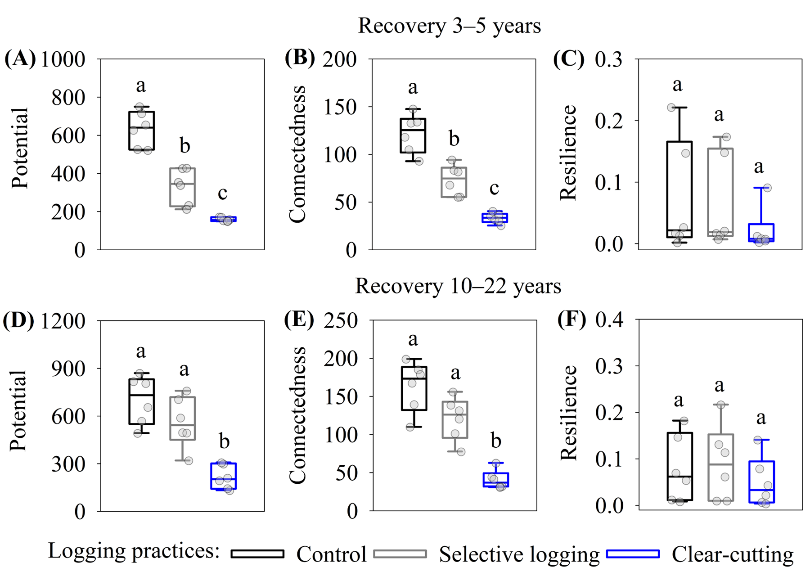
Figure 1. Potential (A, D; unitless), connectedness (B, E; unitless) and resilience (C, F; unitless) during the recovery periods of 3–5 and 10–22 years.(Image by YOU Zhangtian)
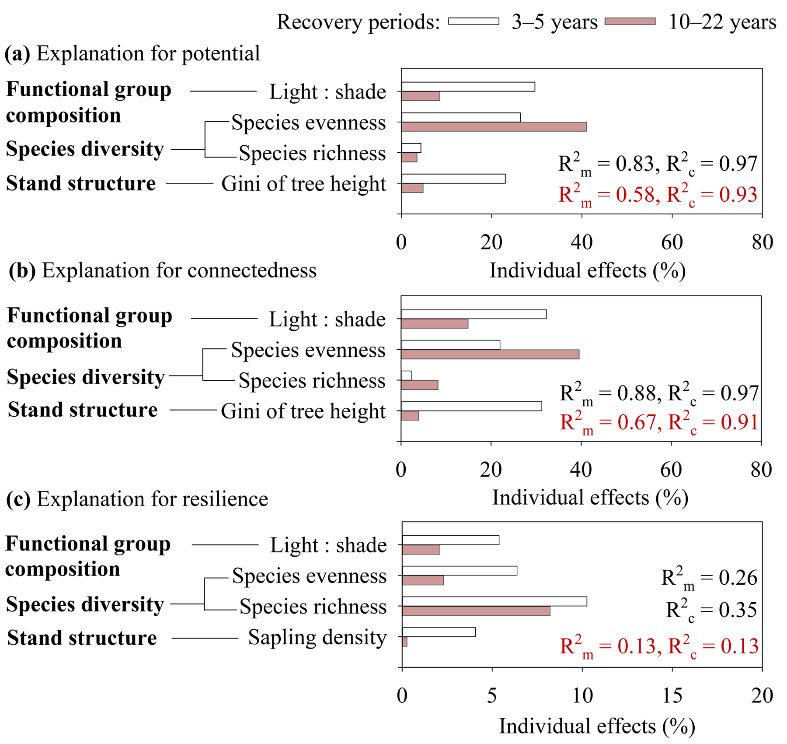
Figure 2. Contributions of species diversity, functional group composition and stand structure to changes in three components of adaptive capacity during the recovery periods of 3–5 and 10–22 years.(Image by YOU Zhangtian)
File Download: